
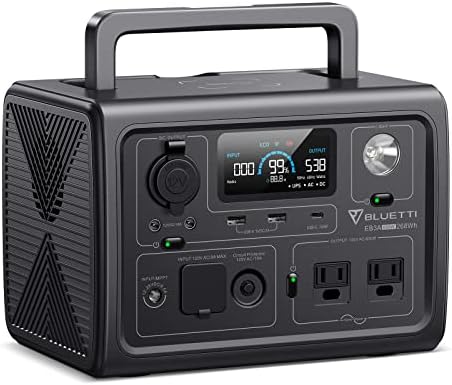
BLUETTI EB3A Portable Power Station
$219 price checked September 2026
BLUETTI EB3A charges to 80% in 30 minutes, so it suits you if fast backup power matters.
268Wh battery capacity
- battery capacity
- 268Wh – below the 300Wh reference figure
- AC output power
- 600W – at or above the 600W AC output reference figure
- AC outlet voltage
- 120V
- recharge time
- 45min
$29 over the category median
- This Portable Power Station
- $219
- Median of the 92 Portable Power Stations we screened
- $189.99
- Range
- $107.99 to $1999
- Cheaper than this one
- 54 of those 92
4.1/5 from 6,002 buyers
- Average buyer rating
- 4.1 out of 5
- Ratings behind it
- 6,002
- What that supports
- A large enough sample to read as a real buyer signal
- Where it comes from
- The product listing, read 24 September 2026
Suits apartment renters during short power outages
- Apartment renters during short power outages
- Remote workers with a desk setup
- Car campers and weekend campers
- Photography and content creators on location
Tick what applies to you – 6 things worth checking before you order
Its battery capacity is 268Wh, below the 300Wh figure – roughly the floor for a useful overnight phone/laptop backup.
Its battery capacity is 268Wh, below the 1000Wh figure – the point where you can run higher-draw appliances for meaningful periods.
Its AC output power is 600W, at or above the 600W AC output figure – covers many small appliances and most consumer electronics chargers.
Its AC output power is 600W, below the 1800W AC output figure – reaches the class that can handle kettles, microwaves, and many home backup loads.
This one is $219, above the $189.99 median of the 92 we screened – it undercuts 36 of them.
It has 6,002 ratings at 4.1/5, above the 625-rating median of its comparables – it ranks #77 of 92 on rating.
Where the EB3A Fits
BLUETTI EB3A Portable Power Station delivers 600W AC output for you if you need a compact battery power station for small appliances and chargers.
If you are packing for blackout backup, car travel, or a campsite where space is tight, 268Wh changes how much stored energy you can carry. That capacity is the limit that matters before runtime even enters the conversation.
BLUETTI EB3A Portable Power Station fits that use with a 268Wh LiFePO4 battery pack, instant UPS backup, and nine outlets. Its built-in MPPT controller also supports solar charging, with up to 200W solar input.
We screened 92 Portable Power Stations and this is one of 15 chosen for a full review. Full reviews go to the most-rated products that pass screening, at most 2 per brand. EB3A had 6,002 buyer ratings, the 4th most of the 92 screened. The price is around $219, and the rating is 4.1 from 6,002 buyer ratings. This review is for you if you care more about stored energy and backup behavior than about running larger appliances.
If you need more capacity, explore our full review of the MBM82SE.
How Price Review HQ picked: we started from the 200 most-reviewed portable power station listings in our retail dataset, removed duplicates, accessories and off-category products, and 92 qualified. This product is one of 15 from that pool chosen for a full review. Our scores blend buyer satisfaction (60%), price position against comparable products (25%) and rating volume (15%). Specifications come from manufacturer listings and ratings from verified Amazon buyer reviews (data checked September 2026).
The Short Answer on the EB3A
Best for: you need a 268Wh portable power station with 600W AC output and fast recharge for short backup runs and light AC loads.
EB3A is the right buy if you want LiFePO4 cells, 120V AC, and a full charge in 45 minutes, around $219.
- Pro: The 45-minute full charge cuts downtime after an outage or between trips.
- Pro: Its 600W inverter handles many small appliances and most consumer electronics chargers.
- Pro: LiFePO4 cells and a stated 3,000-plus recharge life support long-cycle use.
- Con: 268Wh limits runtime, so you should not expect long backup for higher-draw gear.
- Con: The 600W output rules out kettles and microwaves, which need more AC power than this unit provides.
Don’t buy this if: you need a portable power station that can run 1,800W appliances or deliver 1,000Wh-class runtime.
Price assessment: Around $219 is fair for the capacity, 600W output, and 45-minute recharge speed.
Price Review HQ score: 7.3/10 (data-driven – see “How we picked” above)
You might also prefer how the SPS-155 performs for smaller setups.
The Specifications That Matter for This Portable Power Station
| Spec name | Value |
|---|---|
| Battery capacity | 268Wh |
| AC output power | 600W |
| AC outlet voltage | 120V |
| Recharge time | 45min |
| Battery cell type | LiFePO4 |
| Outlets | 9 |
| Solar input | Up to 200W |
| Input via single charging cable | Up to 350W |
| Recharges | Over 3000 times |
| Included items | AC charging cable, solar charging cable, user manual |
Recharge time most separates the EB3A here. It measures how long the battery takes to refill from empty to full under stated conditions.
Before You Buy: Portable Power Station Checklist
The first thing to check is whether 600W AC output is enough for the devices you plan to run, because a mismatch will leave you with a return or a second purchase.
- ☐ Confirm your load stays within the 600W AC inverter — if it does not, the EB3A will trip or shut off when the appliance starts.
- ☐ Check that 268Wh covers your runtime needs — if it does not, you will power the device but run out sooner than you planned.
- ☐ Measure your backup window against the 45 min full charge time — if that refill time is too slow for your outage plan, you will have to live with longer downtime.
- ☐ Confirm your device can use 120V AC — if it cannot, you will need a different station or an adapter setup that may not solve the mismatch.
- ☐ Check that you need pass-through use, because this model has instant UPS backup and PV+AC simultaneous charging to 80% SOC in 30 min — if your gear needs uninterrupted power during charging, a non-pass-through unit would force a different buy.
- ☐ Budget for the recharge source you will use, since input goes up to 350W via a single charging cable and solar input reaches 200W — if neither source fits your setup, you will need another charging plan.
Do not buy the EB3A if you need more than 600W AC output, longer runtime from a 268Wh battery, or a different AC voltage than 120V.
Performance: What the Specs Deliver
Fast Recharge Through Wall Power and Single-Cable Input
The EB3A’s 45-minute full charge makes daily wall charging workable if you can plug it in between uses. A 30-minute fast-charge claim and input up to 350W through a single cable mean you are not waiting around for a long refill after a short outage or commute stop.
That recharge time matters more than extra capacity for daily carry, because 268Wh is enough for modest backup while the refill stays short. If your routine depends on a mini fridge or another steady load, count the hours you need between wall access and use; short gaps favor this unit, while long gaps make the 45-minute refill less important than stored energy.
Solar Input Up to 200W for Small Panel Setups
EB3A accepts up to 200W of solar input, so a small panel setup can keep the station useful away from wall power. The built-in MPPT controller and compatibility with BLUETTI 100W and 200W panels make it a practical match for day trips, van use, or backup charging where sunlight is your main source.
The solar side is sized for topping up a 268Wh battery, not for running high-draw loads all day. If you want to rely on solar, measure your panel wattage and your daylight window; 100W or 200W panels can support regular replenishment, while larger energy needs will outpace the stored capacity and the 200W input limit.
Backup Power From a 600W Inverter and 120V Output
Backup power on the EB3A centers on a 600W AC inverter and 120V output, which is enough for many small appliances and most laptop chargers. The 9 outlets and instant UPS backup also make it easier to keep a modem, laptop, or CPAP running through a short interruption without rearranging a lot of adapters.
What you should check is the startup draw of the device you want to power. A mini fridge can be a fit only if its starting wattage stays within the 600W limit, while heavier household loads are out of scope; the 268Wh battery also means runtime, not just wattage, is the other constraint you need to watch.
How the EB3A Compares to Other Portable Battery Generators
EB3A’s clearest edge is speed: it reaches a full charge in 45 minutes, and its 600W inverter gives you more AC headroom than several cheaper rivals.
- Against the BLUETTI AC50B, EB3A gives up capacity at 268Wh versus 448Wh, so the AC50B suits longer runtimes better.
- Against the VTOMAN FlashSpeed 300, EB3A has the faster recharge at 45 minutes, while the VTOMAN lists 2.5 hours.
- Against the NEXPOW unit, EB3A gives you 120V AC output instead of 110V, which matters if your gear expects standard household voltage.
- Against the BigBlue unit, EB3A includes LiFePO4 cells, while the BigBlue listing does not state its battery chemistry.
If you want the longer-running pick, choose the BLUETTI AC50B instead. Its 448Wh battery gives you more stored energy, while EB3A favors faster turnaround and a smaller pack.
What the deciding spec costs here: Measured as price per unit of AC output power, the reviewed product works out to $0.37 against a $0.47 median across the 89 other screened products that state the spec, and 28 of them deliver more of it per dollar. The cheapest screened product that beats its 600W is the DaranEner NEO at $129.98 with 2600W, which is $89.02 less than this one for more of the spec that decides this category.
For those on the go, see the top-rated portable power station for travel.
Where This Price Sits Among Similar Portable Power Stations
At around $219, the EB3A sits just above the $208 average for the similar portable power station products we compared it against. That price buys a 268Wh LiFePO4 battery pack, a 600W AC inverter, nine outlets, and 45-minute full charging, so you are paying for fast refill and modest stored energy rather than long runtime.
The EB3A makes sense if you want a portable power station you can recharge quickly and keep in service over years, because it is rated for over 3,000 recharge cycles and a 10-year lifespan. If you need longer backup from the same budget, the 268Wh capacity is the limit to watch, since it will age into a smaller daily-use buffer faster than a larger pack.
Where this sits in the buyer data: Among the 92 products screened for this category, this one’s 4.1 rating places it #77, on 6,002 ratings – above the 625-rating median of that group, so the average rests on more feedback than most of its comparables. On price it undercuts 36 of them.
From Delivery to First Use with This Portable Battery Generator
What EB3A needs before first power-up
EB3A needs a charging source before it can do anything useful.
- Unpack the EB3A, the AC charging cable, the solar charging cable, and the user manual.
- Connect the AC charging cable to a source that can supply up to 350W.
- Start a full recharge and wait 45 minutes for the battery to fill from empty.
- Use the solar charging cable only with BLUETTI 100W or 200W solar panels if you plan to charge from solar.
- Are you planning to run devices during charging? The EB3A supports instant UPS backup.
Warranty and support checks for EB3A
Warranty cover differs by seller and country.
- Confirm the seller’s return window for the 268Wh battery pack, because a short window leaves little time to spot charging or output issues.
- Confirm whether the 600W inverter is covered as a separate component, because AC output is the main limit that shapes what the unit can run.
- Confirm who handles support for the LiFePO4 cells, because the pack is rated for over 3,000 recharge cycles and replacement terms matter.
- Confirm whether accessories such as the AC charging cable and solar charging cable are covered, because missing cables block charging.
On arrival, plug EB3A in and start a full charge right away while the return window is still open.
The EB3A: Remaining Questions
Does the BLUETTI EB3A stay quiet and safe indoors?
When you place a portable power station beside a desk or bed, you want to know what the charging and battery specs say about indoor use. EB3A uses LiFePO4 cells, has an instant UPS backup mode, and can refill in 45 minutes; the data does not state fan noise, heat output, or any indoor safety certification.
How much can the BLUETTI EB3A store?
EB3A stores 268Wh, which is the energy figure that matters for runtime planning. That amount suits smaller backup jobs more than long outages, and the 268Wh figure is the one to compare against your device’s draw and expected hours.
Can the BLUETTI EB3A run higher-watt appliances?
No, the EB3A’s AC output is 600W, so you need to stay within that limit for AC loads. That output works for many small appliances and chargers, but wattage mismatch is the failure mode to avoid with startup-heavy gear.
Is the BLUETTI EB3A worth buying at around $219?
The EB3A makes sense if you want a compact portable power station with 600W AC output, 268Wh storage, and very fast recharge. Around $219 is the price context here, and the 4.1 average from 6,002 buyer ratings adds market context without changing the spec limits.
To understand the technology behind these units, view the different types of battery power stations explained.
Is the EB3A Right for You?
The EB3A suits 6 kinds of buyer and is the wrong choice for 5 jobs, listed below with the reason for each.
Who this portable power station is for, and what it does well
Who the EB3A suits
- Apartment renters during short power outages — 268Wh capacity with instant UPS backup can keep a router, laptop, or small light running briefly
- Remote workers with a desk setup — 600W AC output and 9 outlets can cover a laptop, monitor, modem, and phone charging at once
- Car campers and weekend campers — 268Wh LiFePO4 battery and up to 200W solar input suit light off-grid charging and small appliances
- Photography and content creators on location — fast 45 min recharge and multiple outlets help keep batteries, lights, and a laptop powered between shoots
- Students in labs or maker spaces — 600W inverter and compact 268Wh pack are enough for small tools, chargers, and backup power for brief sessions
- Homeowners wanting emergency backup for essentials — instant UPS backup and 30 min to 80% with PV+AC charging make it practical for outages
What this portable battery generator handles well
- Keeping a Wi-Fi router and modem running during a blackout — instant UPS backup and 600W AC output
- Charging a laptop, phone, and tablet together — 9 outlets and 600W AC inverter
- Powering a small desk fan or LED lamp — 600W AC output and 120V AC outlet voltage
- Running a CPAP machine or similar low-draw medical device — 268Wh battery pack and 600W inverter
- Weekend camping power for lights and device charging — 268Wh capacity and up to 200W solar input
- Fast top-ups between uses — full charge in 45 min and input up to 350W via single charging cable
What this battery power station is the wrong choice for
- Running a space heater — 600W AC inverter is too low for heater-level loads
- Powering a microwave or electric kettle — 600W AC output cannot handle those high-wattage appliances
- Whole-home backup during long outages — 268Wh battery capacity is far too small for extended household use
- Using large air conditioners or power tools — 600W inverter and 120V output limit heavy startup loads
- Charging only from a big solar array — up to 200W solar input caps solar charging well below larger off-grid setups
What to budget alongside this portable power station, and what to skip
Accessories worth buying with the EB3A
- AC wall outlet — needed to recharge through the included AC charging cable
- Solar panel — needed if you want to use the built-in MPPT controller and solar charging cable
- Extension cord — needed to place the unit away from the wall while still using AC charging or powering devices
- Power strips — needed to expand the limited built-in outlet count for multiple low-draw devices
- Device charging cables — needed because the power station provides power but not the cables for your phones, laptop, or other gear
Accessories you can skip buying for this portable power station
- Extra battery pack — the unit is a self-contained 268Wh power station, so a separate battery is unnecessary for basic use
- Separate solar charge controller — the built-in MPPT controller already handles solar charging
- Replacement AC charging cable — one AC charging cable is already included
- Replacement solar charging cable — one solar charging cable is already included
Patients should look at our guide to the best portable power station for CPAP.
Where to Buy This Portable Power Station
These retailers sell Portable Power Station generally – we do not track which of them has this particular model in stock, so check availability and the current price with the retailer before making a trip.
- EcoFlow (online only) — specialist brand store for direct-from-manufacturer options
- Amazon (online only) — breadth of range across many brands and capacities
- Best Buy (online and physical stores) — in-store returns and a mix of mainstream models
- Home Depot (online and physical stores) — practical selection for home backup and outdoor use
- REI (online and physical stores) — specialist staff and camping/outdoor-focused assortment
- Walmart (online and physical stores) — broad mass-market selection and easy local pickup
- B&H Photo Video (online only) — breadth of range and knowledgeable category focus
Consider the spec breakdown for the DELTA 2 for high-output needs.
Many outdoor enthusiasts find the top-rated models for camping highly reliable.
Final Verdict on the EB3A
You need a compact portable power station for short backup runs, USB charging, and light AC loads. The EB3A sits around $219, and its 268Wh LiFePO4 battery with 600W AC output makes sense for that job.
The 45-minute full charge is the clearest strength here. That recharge time matters like refilling a water bottle between outings: you get it back in service quickly, but the 268Wh capacity still limits runtime for larger loads.
Skip it if: you need longer backup runtime, or you plan to run kettles, microwaves, or other heavy loads. A 1000Wh class unit or higher AC output serves those jobs better.