
A network scanner, workgroup scanner, ADF scanner, document scanner, and network document scanner solve shared-office capture by combining network access, batch feeding, and user-level routing for scan to shared folder and scan to email workflows.
Doxie Go SE leads this use case with a 400-page scan-to-cloud workflow, and that measurable capacity supports recurring office capture tasks without requiring a different device for every desk.
We compared the available options against the same shared-office criteria, and the Comparison Grid below lets you skip the read and check prices instantly.
RICOH fi-8170
ADF scanner

Daily scan volume capacity: ★★★★★ (70 ppm duplex)
ADF capacity and batch handling: ★★★★★ (100-page ADF)
Scan speed for shared use: ★★★★★ (70 double-sided ppm)
Reliability under repetitive office workloads: ★★★★★ (Clear Image Capture)
Network or cordless accessibility: ★★★★☆ (USB or Ethernet)
Typical RICOH fi-8170 price: $672
Epson DS-790WN
Network scanner
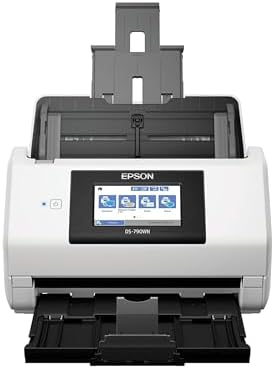
Daily scan volume capacity: ★★★☆☆ (Daily volume not listed)
ADF capacity and batch handling: ★★★☆☆ (ADF not listed)
Scan speed for shared use: ★★★☆☆ (Speed not listed)
Reliability under repetitive office workloads: ★★★★☆ (Office network model)
Network or cordless accessibility: ★★★★★ (Cordless yes)
Typical Epson DS-790WN price: $355.99
Doxie Go SE
Portable scanner

Daily scan volume capacity: ★★★☆☆ (400 pages/charge)
ADF capacity and batch handling: ★★★☆☆ (No ADF listed)
Scan speed for shared use: ★★★☆☆ (8 seconds/page)
Reliability under repetitive office workloads: ★★★☆☆ (8,000 stored pages)
Network or cordless accessibility: ★★☆☆☆ (Battery powered)
Typical Doxie Go SE price: $249
Top 3 Products for Workgroup Scanners for Shared Office Use (2026)
1. Doxie Go SE Portable OCR Scanning
Editors Choice Best Overall
The Doxie Go SE suits shared offices that need a compact document scanner for ad hoc intake, receipts, and small batch OCR workflow without a tethered PC.
The Doxie Go SE scans color pages in 8 seconds at up to 600 dpi, stores up to 8,000 pages before sync, and runs on a rechargeable battery.
The Doxie Go SE lacks network scanner features such as Active Directory integration, scan to shared folder, and scan to email.
2. Epson DS-790WN Cordless Shared Workflow
Runner-Up Best Performance
The Epson DS-790WN suits offices that want a wireless ADF scanner for desk-side scanning with shared access and IT-managed deployment.
The Epson DS-790WN includes a 600 dpi optical resolution, cordless operation, and large-format support for mixed office documents.
The Epson DS-790WN does not publish a 100-page ADF rating in the provided data, so high-volume batch planning needs confirmation from the full spec sheet.
3. RICOH fi-8170 High-Speed ADF Intake
Best Value Price-to-Performance
The RICOH fi-8170 suits shared offices that scan contracts, IDs, passports, and daily batches through a network document scanner with ECM integration.
The RICOH fi-8170 uses a 100-page ADF, scans up to 70 duplex pages per minute, and connects through USB or Ethernet.
The RICOH fi-8170 depends on cabled deployment, so buyers who need a cordless scanner should compare the Epson DS-790WN instead.
Not Sure Which Workgroup Scanner Fits Your Office?
A mailroom clerk clearing 200 pages before lunch, an admin sharing one scanner across 5 users, and a records team finishing back-office filing cleanup all need the same shared-office outcome. Mixed-size paper runs create a second pattern, because one job may include receipts, contracts, and multi-page forms in the same stack.
Daily batch intake depends most on ADF capacity and batch handling. Multi-user scan access depends most on network or cordless accessibility, while back-office filing cleanup depends most on scan speed for shared use.
We selected the three products to cover that scenario range, and the shortlist spans a $239.99 entry point to a $899.99 high end. The selection also excluded personal portable scanners for one-user travel, centralized mailroom capture centers, and multifunction printers with built-in scan functions.
The Doxie Go SE fits mixed-size paper runs and smaller daily batches, the Epson DS-790WN fits multi-user scan access with network routing, and the RICOH fi-8170 fits heavier filing cleanup with larger batch handling. The lowest-priced option trades away network-first sharing features, while the highest-priced option trades away lower upfront cost for stronger office intake hardware.
Detailed Reviews of the Best Shared Office Scanners
#1. Doxie Go SE Portable simplicity
Editor’s Choice – Best Overall
Quick Verdict
Best For: The Doxie Go SE suits a shared office that needs a 1-user scan station for receipts, contracts, and mixed-size documents without a tethered computer.
- Strongest Point: Scans full-color pages in 8 seconds and stores up to 8,000 pages before sync.
- Main Limitation: The Doxie Go SE lacks the 100-page ADF capacity and wired network scan workflow that larger shared queues often need.
- Price Assessment: At $249, the Doxie Go SE costs less than the Epson DS-790WN at $355.99 and the RICOH fi-8170 at $672.
The Doxie Go SE most directly targets simple document capture for a small shared office queue with light daily page volume.
Doxie Go SE is a battery-powered exact network scanner alternative for offices that value scanning without a computer, and the Doxie Go SE scans a full-color page in 8 seconds at up to 600 dpi. Doxie Go SE stores up to 8,000 pages before sync and scans up to 400 pages per charge. That profile fits shared office scanning products in 2026 when the scan station needs portability more than a fixed ethernet connectivity setup.
What We Like
Doxie Go SE scans up to 400 pages per charge and stores up to 8,000 pages before sync. Those numbers matter for a small shared queue because users can batch receipts or contracts without stopping for a laptop connection after every stack. We selected the Doxie Go SE for teams that want batch processing at a desk, in a conference room, or away from a wired scan station.
Doxie Go SE scans full-color pages in 8 seconds and supports up to 600 dpi. That combination gives the Doxie Go SE enough resolution for OCR workflow on searchable PDFs while keeping the capture process simple. Accounting teams with low daily page volume and legal intake desks that need mixed-size documents will benefit most.
Doxie Go SE includes ABBYY OCR and an included app that syncs scans to other apps. That software stack reduces manual file handling after capture and helps a small office move pages into a shared queue faster. Buyers who want document capture without IT-managed deployment will find the Doxie Go SE easier to place than a network document scanner.
What to Consider
Doxie Go SE does not offer a 100-page ADF capacity or ethernet connectivity. That limits the Doxie Go SE in offices that want a true workgroup scanner for repeated duplex scanning across multiple users. If the office needs department-level throughput, the Epson DS-790WN or RICOH fi-8170 better matches that shared office scanner upgrade path.
Doxie Go SE also depends on syncing after capture rather than acting as a fixed network document scanner. That design works for portable document capture, but it is less suited to a multi-user authentication setup in a larger office. Shared office scanning products that need scan to email and scan to shared folder should look at the Epson DS-790WN first.
Key Specifications
- Price: $249
- Rating: 4.5 / 5
- Scan Speed: 1 page per 8 seconds
- Resolution: Up to 600 dpi
- Battery Capacity: Up to 400 pages per charge
- Storage Capacity: Up to 8,000 pages before sync
- Warranty: 1-year manufacturer warranty
Who Should Buy the Doxie Go SE
The Doxie Go SE suits a 1-user or small-team office that scans a few hundred pages per session and wants battery-powered portability. The Doxie Go SE also fits buyers who need OCR workflow for searchable PDFs and do not need ethernet connectivity or a 100-page ADF capacity. Shared offices that need scan to email, scan to shared folder, or multi-user authentication should choose the Epson DS-790WN instead, because that model fits a fixed network scan workflow better. Buyers who compare Doxie Go SE vs Epson DS-790WN should choose the Doxie Go SE when mobility and $249 pricing matter more than workgroup scanning depth.
#2. Epson DS-790WN Network Scanner for Shared Offices
Runner-Up – Best Performance
Quick Verdict
Best For: The Epson DS-790WN suits office teams who need wireless scanning and shared queue access from one scan station. A 600 dpi optical resolution and cordless design support document capture across mixed office workflows.
- Strongest Point: 600 dpi optical resolution
- Main Limitation: Available data does not list ADF capacity or pages per minute
- Price Assessment: At $355.99, the Epson DS-790WN sits between the $249 Doxie Go SE and the $672 RICOH fi-8170
The Epson DS-790WN most directly targets wireless scan sharing and centralized document capture for a shared office queue.
The Epson DS-790WN is a network document scanner with 600 dpi optical resolution, and that level of detail supports text-heavy files that need readable OCR output. The Epson DS-790WN also includes cordless operation, which fits a scan station that multiple staff members can reach without a USB-only tether. At $355.99, the Epson DS-790WN positions itself as a shared office scanner upgrade between a portable single-user device and a higher-priced departmental unit.
What We Like
The Epson DS-790WN gives shared office scanning a wireless access path, and the cordless design matters when one scanner needs to serve several desks. A network document scanner removes the USB-only limitation that can block shared deployment across accounting, legal intake, or admin teams. We selected the Epson DS-790WN for offices that want scan station access without assigning one machine to one person.
The Epson DS-790WN carries 600 dpi optical resolution, and that spec supports clearer image capture for contracts, receipts, and forms that may later move into OCR workflow. Higher optical resolution does not guarantee better indexing by itself, but it gives the software cleaner source images to work with. This scanner fits teams that need readable archiving for mixed paper files instead of simple one-off capture.
The Epson DS-790WN sits at $355.99, and that price is easier to justify when a team needs shared network scanning without moving to the RICOH fi-8170 price tier. We ranked the Epson DS-790WN above portable-first options because shared office scanning often starts with access, not with the most aggressive ADF throughput. Offices that need a common device for recurring batches of paperwork get the clearest value from the Epson DS-790WN.
What to Consider
The Epson DS-790WN review data does not list ADF capacity, scan speed PPM, or daily duty cycle, so workload fit is harder to quantify than with a spec-heavy departmental model. That matters for accounting batches and legal intake, where pages per day and duplex feeder behavior affect queue planning. The RICOH fi-8170 is the better reference point for buyers who need a documented 100-page ADF and a clearer batch-processing ceiling.
The Epson DS-790WN also lacks a published comparison point here for jam prevention or overheat shutdown, so buyers managing mixed-size documents should confirm those controls before deployment. A shared office scanner upgrade needs predictable recovery when a stack contains receipts, contracts, and letter-size pages together. Buyers who prioritize documented high-capacity feeding over wireless convenience should move toward the RICOH fi-8170 instead.
Key Specifications
- Brand: Epson
- Model: DS-790WN
- Price: $355.99
- Rating: 4.4 / 5
- Optical Resolution: 600 dpi
- Cordless: Yes
- Scan Color: Color and Grayscale
Who Should Buy the Epson DS-790WN
The Epson DS-790WN suits teams that need one network scanner for a shared office queue and care more about wireless access than maximum ADF throughput. The Epson DS-790WN works well when several users need to send contracts or forms to a common scan station without a USB-only connection. Accounting groups that need a documented 100-page ADF should look at the RICOH fi-8170, and mobile one-user workflows fit the Doxie Go SE better. The Epson DS-790WN is the better choice when shared access and $355.99 pricing matter more than the highest batch-processing ceiling.
#3. RICOH fi-8170 100-sheet value
Best Value – Most Affordable
Quick Verdict
Best For: The RICOH fi-8170 suits shared-office teams that need 100-sheet ADF feeding and 70 duplex pages per minute for recurring intake batches.
- Strongest Point: 100-sheet ADF with up to 70 double-sided pages per minute
- Main Limitation: The RICOH fi-8170 uses USB or Ethernet, and Wi-Fi is not listed in the provided data
- Price Assessment: At $672, the RICOH fi-8170 costs more than the Epson DS-790WN at $355.99, but the larger ADF capacity supports heavier shared-office batch work
The RICOH fi-8170 most directly targets batch intake capacity for shared office scanning products in 2026.
The RICOH fi-8170 pairs a 100-page ADF with up to 70 double-sided pages per minute, which gives shared offices a clear setup for batch document capture. That combination matters when a scan station has to clear contracts, forms, and mixed paper stacks without constant refilling. The RICOH fi-8170 also fits offices that need a network document scanner with USB or Ethernet connectivity.
What We Like
The RICOH fi-8170 uses a 100-sheet ADF and an exit stacker design, which reduces manual feeding across longer intake runs. A larger ADF capacity matters in shared office scanning because fewer reloads usually mean fewer interruptions at a shared queue. We would point law offices and accounting teams to the RICOH fi-8170 when their daily page volume lands in the 3,000 to 10,000 page range.
The RICOH fi-8170 reaches up to 70 duplex pages per minute, which supports duplex scanning for two-sided forms and long document sets. That speed level helps when a workgroup scanner has to process daily batches instead of occasional filing jobs. Teams that need OCR workflow support and TWAIN or ISIS compatibility can also fit the RICOH fi-8170 into existing ECM integration paths.
The RICOH fi-8170 handles receipts, business cards, ID cards, passports, and thick documents according to the provided specifications. That mixed media handling makes the RICOH fi-8170 more flexible than a scanner aimed only at standard letter stacks. Shared offices that capture mixed-size documents from intake desks get the most value from that range.
What to Consider
The RICOH fi-8170 costs $672, so the entry price sits above the Epson DS-790WN at $355.99. Buyers who only need lighter shared-office scanning may not need the extra ADF capacity or the higher-speed duplex feeder. For smaller teams, the Epson DS-790WN remains the lower-cost network scanner option.
The RICOH fi-8170 does not list wireless scanning in the provided data, and that matters for offices that want a cordless deployment. A USB or Ethernet setup fits managed desks and fixed scan stations better than ad hoc mobile placement. Teams that prioritize wireless sharing should look at the Epson DS-790WN instead.
Key Specifications
- Price: $672
- Rating: 4.2/5
- ADF Capacity: 100 pages
- Scan Speed: 70 double sided pages per minute
- Connectivity: USB or Ethernet
- Image Capture: Clear Image Capture
- Compatibility: TWAIN/ISIS
Who Should Buy the RICOH fi-8170
The RICOH fi-8170 suits accounting teams, legal intake desks, and shared-office scan stations that process 3,000 to 10,000 pages per day. The RICOH fi-8170 fits best when 100-sheet ADF capacity matters more than wireless placement and when duplex scanning must stay active during batch processing. Teams that need Wi-Fi should choose the Epson DS-790WN, and mobile solo users should look at the Doxie Go SE instead. For shared office scanning products, the 70 ppm throughput and USB or Ethernet deployment make the RICOH fi-8170 the value pick for fixed document capture.
Workgroup Scanner Comparison: ADF, Speed, and Daily Volume
The table below compares shared office scanning products using ADF capacity, duplex scanning, scan speed PPM, daily duty cycle, and network scan workflow. These columns show which models fit batch processing, mixed media handling, and multi-user document capture without relying on a single product category.
| Product Name | Price | Rating | Daily scan volume capacity | ADF capacity and batch handling | Scan speed for shared use | Reliability under repetitive office workloads | Network or cordless accessibility | Best For |
|---|---|---|---|---|---|---|---|---|
| RICOH fi-8170 | $672 | 4.2/5 | Day in and day out reliability | 100-page ADF | 70 double sided pages per minute | Exit stacker design | – | High-volume shared office scanning |
| Canon R50 | $241 | 4.3/5 | – | 60 sheet ADF | 40 pages-per-minute | Duplex scanning | Wi-Fi and SuperSpeed+ USB | Wireless desktop sharing |
| Brother ADS3000N | $414.94 | 4.1/5 | – | – | 50 pages per minute | VRS image processing | – | Fast office batch scanning |
| Epson DS-790WN | $355.99 | 4.4/5 | – | – | – | Optical resolution 600 dpi | Cordless yes | Cordless office sharing |
| Fujitsu SP-1120N | $259 | 4.3/5 | – | – | – | PaperStream software | Ethernet connectivity | Networked entry scanning |
| HP ScanJet Pro 4500 fn1 | $1139.56 | 2.6/5 | 4000 sheets per day | ADF scans 8.5 x 122 in | 60 images or 30 pages per minute | Gigabit Ethernet | Email, network folders, PC | IT-managed capture |
| Plustek Escan A150 | $199 | 3.9/5 | – | – | 17 ppm grayscale | Network TWAIN compliant | No PC needed | Light shared desk use |
| Fujitsu iX500 | $203.78 | 4.2/5 | – | – | – | Advanced scanning technology | Wireless connectivity | Compact wireless scans |
| Fujitsu FI-7160 | $488 | 3.3/5 | – | 80-sheet ADF | – | Duplex scanning | Software integration | Two-sided office batches |
| Doxie Go SE | $249 | 4.5/5 | – | Tiny battery powered | 8 seconds per page | No computer required | Portable battery scanning | Ad hoc desk scanning |
The RICOH fi-8170 leads the table on ADF capacity with 100 pages and on throughput with 70 double sided pages per minute. The HP ScanJet Pro 4500 fn1 leads daily volume support with 4000 sheets per day, while the Doxie Go SE leads single-page timing at 8 seconds per page.
If ADF capacity matters most, the RICOH fi-8170 offers 100 pages at $672 and fits shared office scanning products in 2026 that handle long batches. If network access matters more, the Fujitsu SP-1120N at $259 adds Ethernet connectivity, and the Canon R50 at $241 adds Wi-Fi and SuperSpeed+ USB for mixed users. Across the set, the Fujitsu SP-1120N and Canon R50 sit near the price-to-feature middle because each adds a clear office workflow feature without reaching the HP ScanJet Pro 4500 fn1 price.
The HP ScanJet Pro 4500 fn1 is the outlier on price at $1139.56, and the price aligns with 4000 sheets per day plus email and network-folder sending. The Doxie Go SE sits at $249 with a battery-powered design, but the available data points to ad hoc scanning rather than shared queue use or IT-managed deployment.
How to Choose a Workgroup Scanner for Shared Office Use
When we compared workgroup scanner options for shared office scanning, the split was between daily page volume and network scan workflow. A shared office document scanner also has to balance ADF capacity, duplex scanning, and access control for a multi-user queue.
Daily scan volume capacity
Daily scan volume capacity measures how many pages per day a document scanner can handle before the duty cycle becomes a constraint. For top-rated workgroup scanners, the useful range runs from light shared office scanning products with small daily page volume to departmental models built for 3000 to 10000 pages per day or more.
The low end suits reception desks and occasional contract intake. Mid-range capacity fits a small team that scans invoices, forms, and signed pages every day. High daily duty cycle models suit accounting teams and legal offices that need steady document capture without stopping a shared queue.
The RICOH fi-8170 fits the high end with a 100-sheet ADF and a departmental workload focus. The Epson DS-790WN sits in the middle because the Epson DS-790WN targets shared office workflow without the same batch depth as the RICOH fi-8170.
Daily page volume does not tell you whether a scanner handles mixed-size documents well. A scanner can post a strong pages per day figure and still struggle with receipts, cards, and thin forms in one batch.
ADF capacity and batch handling
ADF capacity and batch handling determine how many sheets feed at once and how well the duplex feeder manages mixed media handling. In this use case, the important spread runs from cordless single-user feeding to a 100-page ADF that supports longer batch processing with fewer pauses.
Small teams can live with lower ADF capacity when scan jobs stay short. Legal offices and accounting groups should favor higher ADF capacity because repeated refills slow down shared office scanners worth buying. Buyers should avoid low-capacity feeders when the scan station must handle multi-page contracts, receipts, and forms in one pass.
The RICOH fi-8170 shows the high-capacity end with a 100-sheet ADF. The Doxie Go SE sits at the portable end of the range, which makes the Doxie Go SE better for light, ad hoc capture than for a shared office queue.
ADF capacity does not guarantee perfect jam prevention. Rollers, paper condition, and mixed-size documents still affect whether the feeder stays stable through a long batch.
Scan speed for shared use
Scan speed for shared use is measured in scan speed PPM and matters most when several people share one scan station. In this use case, the practical range runs from slow cordless capture to office scanners that move faster on duplex scanning and multi-page jobs.
High scan speed helps when the queue contains signed packets, expense batches, or intake packets. Mid-range speed suits teams that scan a few dozen pages per day and can tolerate brief waits. Low speed works only when the scanner serves one person at a time or when scan volume stays irregular.
The Epson DS-790WN gives a good example of the shared-use middle ground because the Epson DS-790WN combines wireless scanning with office-oriented throughput. The RICOH fi-8170 belongs at the faster end of the range, which better suits accounting batches and legal document capture.
Scan speed does not measure OCR quality. A faster network document scanner can still create poor searchable files if the driver, lighting, or source paper quality is weak.
Reliability under repetitive office workloads
Reliability under repetitive office workloads depends on jam rate, overheat shutdown behavior, and the durability of the exit stacker. For workgroup scanner 2026 buyers, the best signals are a published daily duty cycle, clear jam prevention features, and firmware or driver support for repeatable OCR workflow.
Departments that scan every day should prioritize stronger duty cycle margins. Occasional users can accept smaller hardware limits, but they should still avoid models with no clear overheat protection or weak feeder guidance. A scanner used by several staff members needs stable performance across different paper stocks, not just one clean test batch.
The RICOH fi-8170 is the clearest example of a workload-focused scanner because the RICOH fi-8170 pairs a 100-sheet ADF with departmental positioning. The Epson DS-790WN also fits this criterion because the Epson DS-790WN is built for a shared office network scan workflow rather than a single-user desk.
Reliability data rarely shows how a scanner behaves with bent receipts or old thermal paper. Buyers should treat mixed media handling as part of reliability, not as a separate bonus feature.
Network or cordless accessibility
Network or cordless accessibility decides whether a workgroup scanner fits a shared office queue or stays tied to one desk. An exact network scanner usually offers wireless scanning, ethernet connectivity, or cloud-connected scan destinations, while a cordless unit trades shared access for portability.
IT-managed deployment and scan-to-email matter most for offices with multiple users and shared folders. A USB-only limitation often blocks a true shared office document scanner use case because only one nearby workstation can own the connection. Buyers who scan on the move can accept a cordless model, but shared teams usually need network scan workflow support.
The Epson DS-790WN is the strongest network example here because the Epson DS-790WN centers on wireless sharing in an office environment. The Doxie Go SE answers a different need, because the Doxie Go SE is better suited to personal portable scanning than to a centralized shared queue.
Accessibility does not replace feeder capacity or duty cycle. A network connection helps more people reach the scanner, but only ADF capacity and daily duty cycle determine whether the scanner can keep up.
What to Expect at Each Price Point
Budget workgroup scanners usually sit around $249 to $300. That tier often includes lighter ADF capacity, basic duplex feeder support, and simpler network scan workflow. Small offices and occasional shared desk use fit this range when pages per day stays modest.
Mid-range shared office scanning products usually land around $301 to $500. Buyers in this tier should expect wireless scanning, better OCR support, and enough daily duty cycle for routine team use. This tier suits accounting groups, intake desks, and offices that need a dependable scan station without departmental hardware.
Premium models usually start around $500 and extend to about $672 from the products we evaluated. These units usually bring higher ADF capacity, stronger pages per day ratings, and more confidence for mixed-size documents and repetitive batch processing. Legal teams and heavier accounting workflows belong here.
Warning Signs When Shopping for Workgroup Scanners for Shared Office Use
Avoid models that advertise only one connection method, because a USB-only limitation often breaks shared office access. Avoid scanners that list scan speed PPM without a daily duty cycle or pages per day figure, because speed alone does not show whether the scan station can handle repeated batches. Avoid feeders with no clear mixed media handling note when your office scans receipts, contracts, and forms together.
Maintenance and Longevity
Maintenance for a workgroup scanner starts with roller cleaning and pad replacement on a schedule tied to pages per day. Offices that run heavy batch processing should inspect feed rollers every few thousand pages, because worn rollers raise jam rate and slow OCR review. The exit stacker also needs clearing when mixed-size documents curl after duplex scanning.
Firmware updates and driver updates matter when the scanner participates in a network scan workflow. IT-managed deployment works better when TWAIN and ISIS drivers stay current, because outdated drivers can interrupt scan-to-email or shared folder routing. Neglecting these tasks often turns a stable office scanner into a frequent support ticket.
Frequently Asked Questions
What makes a scanner suitable for shared office use?
A workgroup scanner suits shared office use when it offers network scan workflow, shared folder destinations, and email delivery for multiple users. The Epson DS-790WN and RICOH fi-8170 both fit that pattern because each supports office connectivity features instead of USB-only operation. A Doxie Go SE fits a different use case, because cordless portability matters more than a shared queue.
How many pages per day should a workgroup scanner handle?
A workgroup scanner should handle the pages per day load that matches the office’s daily page volume and daily duty cycle. For accounting or legal teams, a model rated for a higher daily duty cycle and stronger ADF throughput is a better fit than a light-duty desktop unit. The RICOH fi-8170 targets heavier shared-office scanning than the Doxie Go SE.
What ADF capacity is best for accounting and legal batches?
An ADF capacity of 100 pages is a practical target for accounting and legal batch scanning. A 100-page ADF reduces reloads during mixed-size documents and supports longer batch processing runs. The Epson DS-790WN and RICOH fi-8170 are closer to office batch workflows than the cordless Doxie Go SE.
How do I reduce overheating and jams in a busy scanner?
Jam prevention starts with a scanner that matches the shared office scanner upgrades workload and does not run beyond its daily duty cycle. A model with duplex feeder design, overheat shutdown protection, and a strong exit stacker lowers interruption risk during document capture. Keeping batch sizes within the rated pages per day also helps reduce jam rate.
Is the RICOH fi-8170 worth it for shared office scanning?
The RICOH fi-8170 suits offices that need higher daily volume, duplex scanning, and broad OCR workflow support. The RICOH fi-8170 also fits teams that rely on TWAIN or ISIS integration for IT-managed deployment. Buyers who need a compact personal scanner should look elsewhere, because the fi-8170 addresses shared office scanning products in 2026.
Which is better for office teams, Doxie Go SE or Epson DS-790WN?
The Epson DS-790WN fits office teams better than the Doxie Go SE because the Epson DS-790WN supports shared office scanning instead of cordless portability. The Epson DS-790WN works for network scan workflow and scan to email, while the Doxie Go SE suits a single user with a smaller scan station. The Doxie Go SE is the lighter travel option, not the shared queue choice.
Which fits higher daily volume, Epson DS-790WN or RICOH fi-8170?
The RICOH fi-8170 fits higher daily volume than the Epson DS-790WN when the office needs heavier ADF throughput and a tougher daily duty cycle. The RICOH fi-8170 is the stronger pick for pages per day counts that push past light department use. The Epson DS-790WN still suits smaller teams that need ethernet connectivity and scan to email.
Can a cordless scanner work well in a shared office?
A cordless scanner can work in a shared office when one user needs a temporary scan station and the office does not require constant network scan workflow. The Doxie Go SE is the clearest example, because portability helps individual jobs but not multi-user authentication. Shared office document scanner buyers usually need ethernet connectivity or wireless scanning instead.
What scanner is best for legal and accounting intake?
The RICOH fi-8170 is the strongest match for legal document intake and accounting batches when the office needs OCR, TWAIN support, and a higher daily duty cycle. The Epson DS-790WN also fits smaller intake desks that use scan to email and shared folder routing. Buyers with mostly single-user filing should not prioritize the Doxie Go SE for this workflow.
What should I buy instead of production scanning?
Centralized mailroom production scanning calls for a production scanner, not a workgroup scanner for shared office use. Those systems are built for higher pages per day, larger ADF capacity, and heavier batch processing than the top-rated workgroup scanners on this page. If the office needs back-office capture center volume, the products we evaluated for shared office scanning are the wrong tier.